There is no such thing as scale colour.
There, I've said it.
For those of you not familiar with
the concept, it is, in a nutshell, that the further away
you get from an object the more our perception of its
colour changes due to atmospheric interference; ie, darker
colours become lighter and lighter colours become darker,
very generally speaking. In the context of modelling,
scale colour is an attempt to capture this full size phenomenon
in miniature so precisely that your brain is fooled into
thinking it’s looking at the real thing parked x
number of feet away instead of a model sitting inches
from your nose. It is the unattainable enlightenment of
Zen modelling.
Take for example a 1/72 scale aircraft
model, where 1 inch equals 6 feet on the real object.
In other words, a model with an 8 inch wingspan scaled
up 72 times would equate to a full size aircraft with
a 48 foot wingspan. By this logic, viewing a model from
an average distance of 12 inches would equate to looking
at the real thing from a distance of 72 feet. Similarly,
a 1/48 scale model viewed from the same distance would
be like looking at the real thing from a distance of 48
feet. According to the scale colour rulebook, paint hues
change proportionate to the distance from the viewer,
therefore a 1/72 scale model would need to have its paint
altered by a greater percentage than a 1/48 scale model
because it represents an object viewed from a greater
distance.
I'm not sure if Ian Huntley is the
instigator but he certainly went into great depth on it
in his series of articles in Scale Aircraft Modelling,
even to the point of coming up with charts giving percentages
that paint must be altered for each of the popular modelling
scales. Harry Woodman, a modeller whose skill I greatly
admired, was also a proponent of the theory. Both cited
the use of the technique by artists as an effective way
of representing distance and perspective in paintings.
Though this was the basis of their arguments for scale
colour, to me it is actually the fundamental flaw in the
theory.
Artists use the technique because they
are attempting to create the illusion of a three-dimensional
world within the constraints of a two-dimensional medium.
Assuming the artist set out to create realism (as opposed
to Cubism, Surrealism or some other kind of ‘ism),
a landscape portrait would lose any semblance of depth
and distance and look amateurish if the mountains in the
background were painted with the same intensity as the
bowl of fruit in the foreground. Our perception of colour
does change over distance, this I am not disputing, and
the principal works very well in a two-dimensional painting.
But we modellers are not working with two-dimensional
subjects, therefore painting them to try and capture a
sense of depth and perspective is not only unnecessary,
it is unrealistic and inaccurate. It works in the painting
because the theoretical distance between the bowl of fruit
and the mountain is fixed and the whole image works as
a single scene with all the elements viewed in context.
It doesn’t work with models because they can be
viewed from any distance and they are clearly models sitting
on a shelf, no matter how they’re painted.
The concept could be put to use in
a large scene where the lighting and viewing angle are
strictly controlled, such as an airfield diorama which
could only be viewed from one end. In this case it would
probably be quite effective to paint the aircraft and
surrounding scenery in progressively altered shades as
the distance between them and the viewer increased. Like
the painting, the distances and viewer’s perspective
are fixed and the elements work together to produce a
single coherent scene. But take those elements out of
that scene and place them side by side and you suddenly
have aircraft that, though they should be the same, look
completely different from each other because they are
being viewed out of context. The faded Hurricane from
the far end of the diorama doesn’t look like the
pictures you have of Hurricanes because the colours are
all wrong and it looks out of place next to the other
Hurricanes on the shelf.
Scale colour seems to be the sole domain
of military modellers and I believe this is the main reason
why it has been so widely accepted without question. Military
models don’t look wrong to our eyes with faded and
dulled paint, not because of any “scale effect”,
but because military subjects fade and get dull! Personally,
I know of no modellers of civilian aircraft or vehicles
who apply scale colour rules to their models, in fact
a couple I mentioned it to gave me a blank stare –
they had never heard of such a thing. This is not surprising
when put into perspective (no pun intended). A Spitfire
with faded and weathered paint looks just fine but a John
Players Special Lotus would look decidedly odd painted
in dark grey with pale gold pinstripes, just as a Quantas
Airbus A380 would in off-white with a pink tail. But how
can this be so? Scale models are miniature representations
of the real thing regardless of the subject matter, therefore
the same rules should apply whether you’re building
shiny racing cars or drab earth movers. The answer is
of course that it’s all in the perception of the
beholder and our expectations when viewing a certain subject.
We expect bright shiny colours on cars and civilian aircraft
just as we expect military subjects to be faded and grimy.
We don’t question the use of scale colour in the
latter genre because it satisfies our expections of a
well used, war weary subject, nor do we frown upon bright
colours in the civilian world because again, it’s
expected. It’s “right”. But the faded
colours on military subjects are not “scale”
colours, they are weathered colours. The modeller may
have painted it with scale colour in mind, but it’s
fooling no one into thinking it’s actually the real
thing parked however many feet away. It looks right because
we have a preconceived idea of what a well used military
vehicle or aircraft should look like and scale colour
rules merely cater to that notion, albeit for all the
wrong reasons.
The basic concept is therefore flawed
in my opinion, but if we insist on adhering to the bizarre
idea of scaling down a colour(!) then we must consider
just how many variables we are actually trying to capture
in order to paint a model so it more closely represents
the real thing viewed from a certain set distance. With
respect to the late Mr. Huntley, the idea of actually
drawing up a chart - even as a rough guide - is ludicrous.
Consider these points:
The original paint could change dramatically for
a good many reasons. Though we may rely heavily on
structured paint references such as the Federal Standard
or Methuen systems, it is not nearly so cut and dried
in the real world. Different paint manufacturers had
different interpretations of the official colour specs
- if there were any - and different paints weathered
in different ways. And during wartime official standards
sometimes went out the window due to lack of supply
of the correct paint. Ground crews often painted aircraft
with whatever paint they had to hand and it may or
may not have been the "correct" colour.
Anybody who has owned a white car knows just how many
variations of white there are when it came time to
buy a spray can of touch up paint.
How can it be said then that olive drab paint must
be lightened by 10% for a 1/72 scale model when the
paint on full size aircraft may change that much or
more from aircraft to aircraft? Which shade do you
lighten and by how much: the factory fresh olive drab
on a P-40B built by Curtiss in 1940, or the weathered
olive drab on a P-51B built by North American in 1943?
Taking samples from original paint on museum examples
is also unreliable. Paint oxidises, fades, and gets
dirty over the years. Austro-Hungarian WW1 aircraft
are a good example. For years it was thought that
some were painted in the so-called "Autumn Leaf" camouflage
- red/brown and green hexagonals painted over a mustard
yellow base. Recent chemical analysis has shown that
the paints used were actually three different shades
of grey, and that the paint and overcoat of varnish
had oxidised over the years and turned into the "Autumn
Leaf" colours. I recommend reading Robert Mikesh's
book "Restoring Museum Aircraft" (Airlife, 1997) for
a good insight into the difficulties of matching paint
from surviving specimens.
I think it's safe to say that most of us work from
photographs of the real object we're modelling, even
with modern subjects. It's just not practical or possible
to visit airfields, military bases or war zones all
the time to match up paint colours, and that just
isn't an option for most historic subjects unless
you have access to a time machine. If anyone out there
does by the way please let me know - I'd love to borrow
it someday just to see if anybody really was on that
grassy knoll in 1963. But I digress....
Photographs bring a whole new set of variables into
the equation. Different film, different cameras, different
lighting, different labs developing the film. Even
two photos of one subject taken from different angles
will show the same paint differently due to refraction.
The digital revolution hasn’t removed these
variations, in fact it has added its own set of idiosyncracies.
It all adds up to incredible variations in colour
when working from photographs.
Above:
Both photos were taken at the same time with the same
digital camera on the same settings. Both are of the
same side of the aircraft but from different angles
and distances. Which grey do I lighten and by how
much to make my model look more like the real thing?
And which angle and distance am I representing? Presumably
I would then only ever be able to look at my model
from the same angle and (scale) distance in order
for it to be a completely faithful reproduction. Note
too that these photos are contrary to the scale colour
rulebook; the aircraft appears much lighter in the
closer picture. Should I not therefore be darkening
the paint to represent an object further away, rather
than lightening it as scale colour says I should?
The hobby paints we are using vary immensely, despite
the fact that many of them claim to be authentic matches.
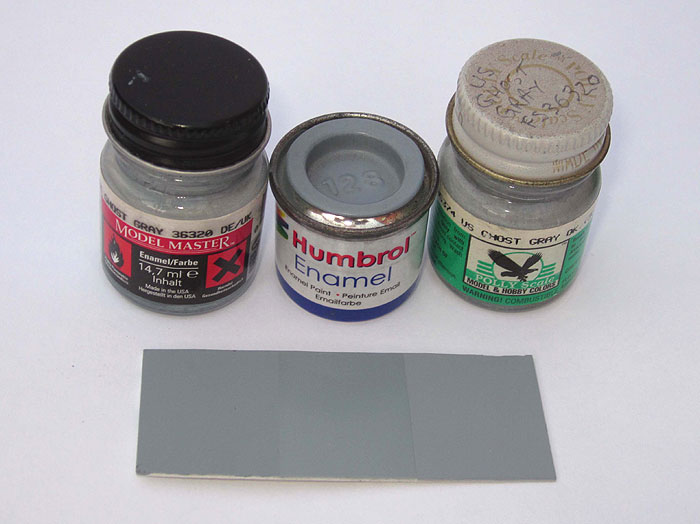
When painting the cockpit of my Hasegawa Tomcat, I
compared paints from Testors, Humbrol and Polly Scale.
All purported to be matched to FS 36320 yet they were
all quite different from each other, and none of them
matched any of the colour photos I had of Tomcat cockpits!
In other words, why change the colour of paint by
a certain pre-ordained amount simply because it's
an "out of the bottle" colour? It could
very well be the wrong shade to begin with and lightening
it will only exacerbate the error.
As an interesting aside, I have several of the same
shades of paint from both Aeromaster and Polly Scale.
Both brands were manufactured by Floquil and were,
for all intents and purposes, the same paints in different
bottles. Aeromaster boasted that its paints were lightened
for "scale effect" while Polly Scale made
no such claims - yet they are exactly the same shades.
It’s obvious that had I altered the Polly Scale
paints for scale effect I would have ended up with
different shades to Aeromaster which already claimed
to be scale colours! Aeromaster, I might add, annoyed
me to no end with its insistance on the use of scale
colour for its decal sheets. Their Japanese markings
in particular were far too orange and really bore
little resemblance to bright red hinomarus. Also the
red in some of their British roundels looked closer
to pink than a brick red. Neither of them looked "right"
to my eye.
And while I’m at it, scale black is just silly.
There is dark grey and there is black, there is no
“scale black” (and before you point it
out, yes I know that there is no such thing as “pure”
black in the paint world anyway). I’m reminded
of a certain Father Ted episode where the differences
between priest black socks and non-priest black socks
are discussed….
Lighting and weather conditions can affect colour
perception immensely. An aircraft viewed in a poorly
lit hangar on a dull day will look completely different
out in bright sunshine. Similarly, a model lit by
a 60 watt desk lamp will appear to be a very different
colour when viewed by fluorescent light, or by natural
light. How then would scale colour be at all relevant
or useful to an object that looks different in varying
light qualities anyway? In order to achieve the Zen
of scale colour, surely I’m limited to displaying
my model in the same quality of light the original
was viewed in?
If we take it to the nth degree, wouldn't 1/700
scale ships end up being a single monotone shade?
Just spray the whole thing; propellers, hull, decks,
superstructure, aircraft - everything - a very pale
grey or off-white and be done with it. It would certainly
simplify the painting process, wouldn't it?
Finally, and to me the paramount reason, I don't
for a second look at my models (or anyone elses’s
models for that matter) and think of them as the real
thing 72 feet away. Call it cynicism, call it a lack
of imagination, but I just can't suspend my disbelief
that much - nor do I particularly want to. They are
supposed to be miniature representations of the full
size object and therefore should be painted in as
close to the same colours as the full size object
as I can get. If an RCAF Harvard is trainer yellow
with a black anti-glare panel then that’s how
my model should be painted, not pale yellow with a
dark grey anti-glare panel. While I try to be as accurate
as I can when building and painting models, my idea
of accurate does not extend to dubious colour changes
based on hypothetical atmospheric conditions and viewing
distances. Models I've seen completed according to
scale colour rules looked to be nicely faded and weathered,
but they didn't look any more like the real thing
parked x number of feet away than the rubber toy in
the original King Kong did a giant ape. They looked
like models with faded paint.
Yes, our perception of colour does
change the further away objects are, I'm not debating
that. What I am saying is that attempting to reproduce
this effect in model form is folly. Distance is but one
variable in a very long list of variables and trying to
compensate for all of them simply by splashing some white
paint in your camouflage colours is not only pointless,
it is no more accurate or realistic than a model painted
with a straight-out-of-the-bottle colour. Why bother researching
colours and worrying about the correct FS paint if you’re
just going to change the final shade anyway? You may just
as well paint it with any old paint that comes to hand.
Furthermore, the practice has been taken completely out
of context, adopted from a different medium with a different
objective that is in no way relevant to scale modelling.
Recreating a distant mountain on a flat piece of canvas
is about as similar to a model of a Sherman tank sitting
in a display cabinet as a Volkswagen Beetle is to a pot
of marmalade. The latter two are exempt from scale colour
rules anyway of course, unless they’re military
issue!
"Scale colour" is, in my
opinion, a modelling fad that has been adopted because
it is considered to be en vogue to do so and
I think many people adhere to it without actually thinking
it through. It has been instilled in us to such an extent
that we automatically see a model as “wrong”
if it has been painted with colours straight out of the
bottle (though really, with all the variations in model
paint, how would we know that if the modeller doesn’t
tell us?!), but the scale colour standards are nothing
more than guesswork based on a flawed concept. I find
it ironic that some people who so fervently worship the
god of accuracy that they get bent out of shape over a
misplaced rivet will think nothing of chucking white paint
willy-nilly in their finish coats in a vain attempt to
adhere to a fantastical ideal. If you want to model a
battle weary vehicle or aircraft with faded paint then
that’s fine, but please don’t tell me it’s
a “scale” colour!
It boils down to this: if you think
it looks right, if you're happy with the way it turned
out, then that's really all that matters. And if anyone
tells you it's not "scale colour", ask them
to prove it!


 Back
to Articles/Reviews Main
Back
to Articles/Reviews Main