The Roden 2F.1 Camel has
been out for over a month now and there's still no sign
of them here in the UK, which is rather ironic since it's
a British aircraft. Being the impatient fellow I am, I
gave up waiting for them and ordered mine from Hobbyterra.
They took about the same amount of time that a certain
large UK mail order establishment takes and their prices
on Roden stuff are less than half. Will I be ordering
all my Roden stuff from them in future? Was the Pope a
member of the Hitler Youth Group?
So, on to the eagerly anticipated (by me anyway) Camel
kit. Well, I'm somewhat disappointed to report that it's
a bit of a mixed bag unfortunately. On the plus side,
the moulding is up to Roden's usual excellent standard,
the engines, props, wheels and guns are excellent and
the struts are nice and fine. There is a nice little Rotherham
pump moulded to one of the cabane struts. The fuselage
is quite well done and cockpit detail is nice and fairly
complete, though the control stick is far too short -
about the right size for Sneezy or Grumpy if they had
been Camel pilots. I like the separate rear deck which
will mean there will be no loss of stringer detail, as
there would be when filling a central seam. There is an
extra throttle and rudder bar which I'm assuming will
be used on the forthcoming 2-seat version.
You get loads of extra parts as is usual with a Roden
kit. There are three engines (Le Rhone, Bentley and a
Clerget), 2 propellers, 2 cowlings, 2 cockpit deckings,
2 Vickers and 1 Lewis gun with spare ammo drums, and a
set of Cooper bombs. A windscreen is printed on clear
acetate, though this isn't necessarily correct for all
aircraft.
Decals look quite nice and include markings for 4 aircraft:
N6603, the fourth production 2F.1; the well known N6602
with its unique lattice fuselage markings; N7149 "Swillington"
and N7120 from HMS Queen Elizabeth. 'Lift here' stencils
and elevator/rudder stripes are included. The red centre
dots are seperate though the white on my sheet was out
of register and the blue may be a bit dark for some people's
tastes.
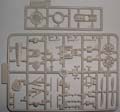
Click and all will be revealed:
On the downside, though
the general dimensions are correct, compared to photographs
and plans there are some fairly major outline errors.
The wings need to have the tips re-shaped, the trailing
edge cut out above the cockpit is too big and the divisions
between the outer panels and the centre section need to
be scribed in. The pulley inspection panels are moulded
in but the one in the centre section is on the left when
it should be on the right. Removing it will mean there
is a blank spot where the l/e sub ribs should be.
The horizontal stab is the worst feature. It is far too
small and the wrong shape entirely. Dig out your old Revell
Camels because the stab is spot on in that kit and the
moulding quality is comparable to Roden's, so it can be
used with little modification.
The fuselage of the 2F.1 was in two sections and could
be disassembled for storage aboard ship - it was often
referred to as the "Ship's Camel" or "Split
Camel" for this reason. The break just behind the
cockpit is scribed in on one side but a raised line on
the other; perhaps Roden thought this was a hinge covered
by a strip of fabric? The lacing on the right side of
the fuselage is represented by a relatively thick featureless
raised line and the vertical part of this behind the cockpit
is missing entirely. Also the rear fuselage has a subtle
sag moulded in between the uprights. The jury's still
out on this. It is subtle but I can't see a hint of any
sag in photos; the fuselage is pretty much flat sided,
even in flight. There is a fairing behind the carburettor
intake that only seems to have been on a very few F.1
Camels and is not a feature of the 2F.1 at all, at least
not that I could see. It certainly wasn't on any of the
aircraft featured on the decal sheet so this will have
to be removed if you wish to model one of them.
The cowling for the Bentley has the right shape (larger
diameter that tapers into the fuselage as opposed to the
straight regular cowling) but Roden has moulded cooling
slots into it that I have yet to find a photo of on any
version of the Camel. These will be very annoying to fill
in. I can't find a good enough picture to determine what
engine N7120 had but the other 3 were Bentley powered
aircraft with the larger upper decking and cowling (parts
1K, 2K & 3K). Roden's instructions say to use the
Clerget engine & small cowl for N6602 but I believe
this to be incorrect as this should be Bentley powered.
All in all, a bit of a disappointment to be honest and
not up to the high standards of other Roden kits. It will
need a fair amount of work to look right and in some respects
it's not as good as the 40 year old Revell kit. The major
airframe components are on a single sprue so these will
(I hope!) be all new parts for the F.1 - let's hope that
they do a better job on that one.
References:
Windsock Datafile 6. J M Bruce, Albatros Productions,
1987, 1996
Sopwith Camel, King of Combat. Chaz Bowyer, Glasney
Press 1978
Sopwith Camel. J M Bruce, Arms & Armour Press,
1989



 Back
to Articles/Reviews Main
Back
to Articles/Reviews Main