A very surprising release,
at least to me anyway. AFV Club has, for many years, specialised
in 1/35 scale armour kits, so a 1/144 scale aircraft kit
was not something I expected to see from them. Released
back in 2015, this was their first effort in that scale.
The basic shapes are there, but an awful lot is either
poorly represented or missing completely. Still, with
a bit of effort it can be made to look like a reasonable
facsimile of a P-40. Their latest 1/144 kits, the Seaking
and F4U Corsair, are superb I might add - far superior
to their line of P-40s (they also do a P-40E and a P-40N).
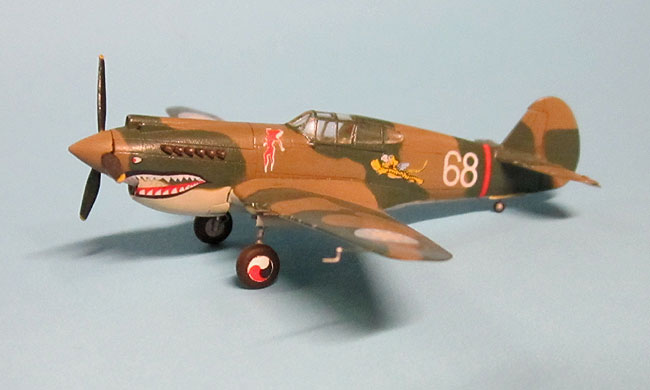
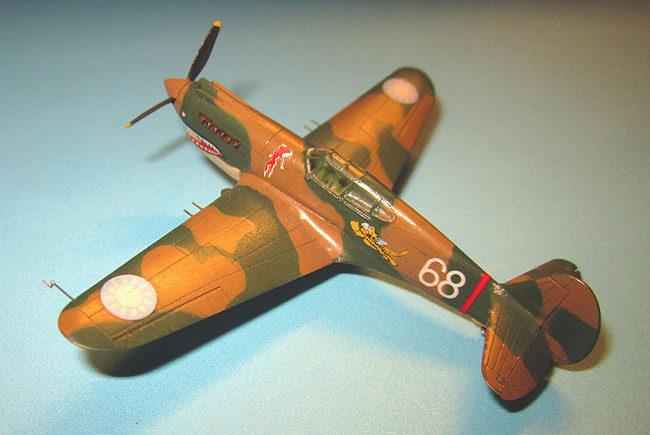
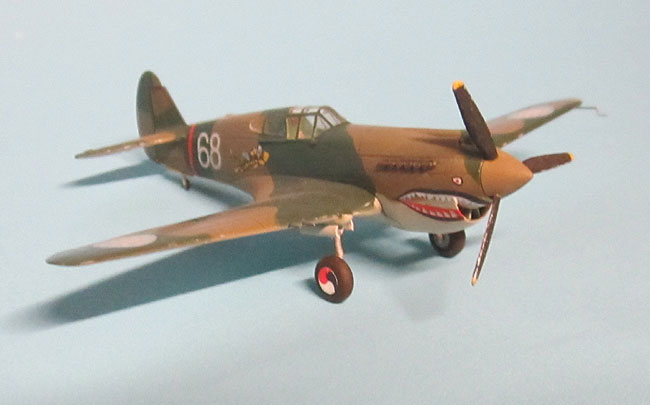
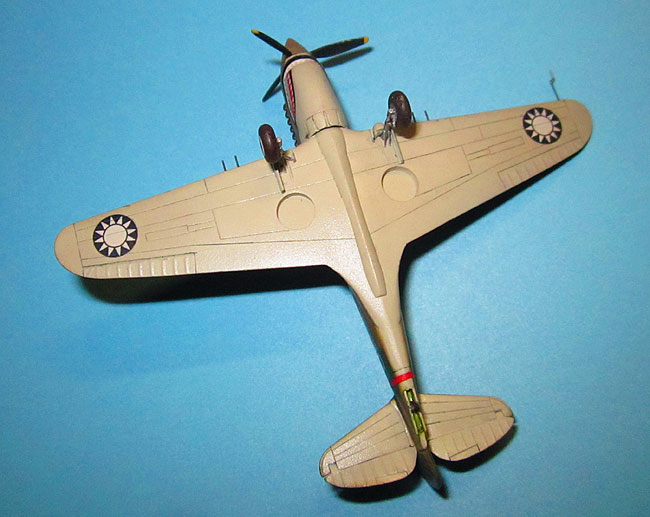
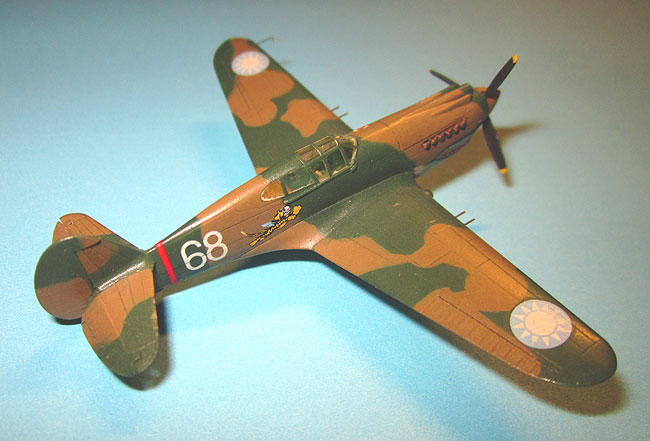
I added a rudimentary cockpit,
opened up and detailed the solid chin intake, corrected
the oversized wheel wells, detailed the landing gear,
and added scratchbuilt landing gear doors and a pitot
tube. The rudder and elevators were cut off and repositioned
and guns were replaced with thin hypodermic tubing. Landing
gear legs are a bit long so these were shortened and the
wheels were improved by carving them away slightly from
the integrally moulded gear legs.
A grossly oversized belly
tank was included with the kit but fortunately not needed
as AVG P-40s did not carry them. AFV Club state that this
is a P-40B/C or a Hawk 81-A2, but in fact the AVG aircraft
were Hawk 81-A1s which were not plumbed for drop tanks.
These aircraft were originally
meant for the RAF but were instead diverted to the American
Volunteer Group in China. Thus they were finished in a
British camouflage pattern, though the colours Curtiss
used were not quite to RAF spec. I used Humbrol Dark Green
(30), Camouflage Grey (28) and US Light Earth (119), the
latter looking closer to the colour pictures I found online
than Humbrol's RAF Dark Earth (29) does, which would normally
be used on an RAF aircraft in this scheme.
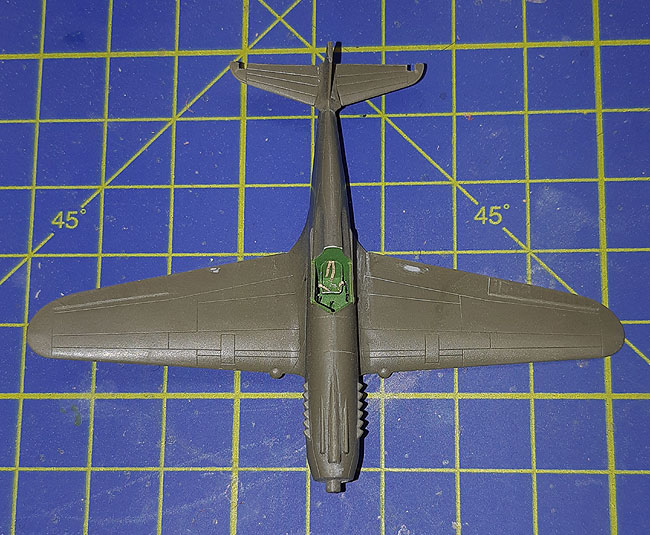
No cockpit detail is provided
in the kit so I moulded a seat and added belts from thin
strips of tape. A control stick, brake lever, instrument
panel and a few other bits 'n' bobs were thrown in for
good measure. It's more than enough under the closed canopy.
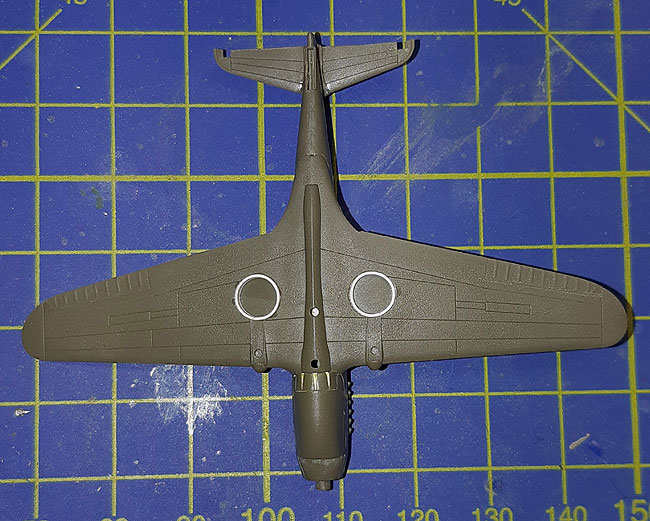
The wheel wells were too
large in diameter. Strips of .020" plastic were wrapped
around a suitably sized drill bit and dipped in hot water
briefly to set the shape. These were fitted in to reduce
the wheel well diameter then filled and sanded flush with
the wing surface once dry.
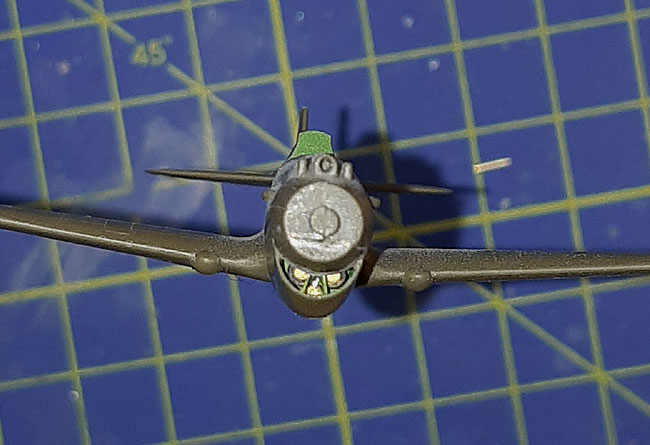
The chin and carb intakes
were completely solid. These were opened out and the oil
cooler and radiators added to the chin intake along with
the diagonal guide vanes.
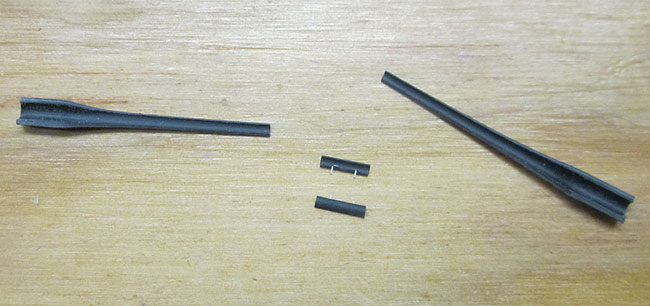
There were no landing gear
doors at all in the kit. A piece of Contrail tubing was
split in half lengthwise and then stretched over a candle
flame to produce the curved doors. Tiny hinges were added
to help position them. This worked surprisingly well and
was quite easy to do.
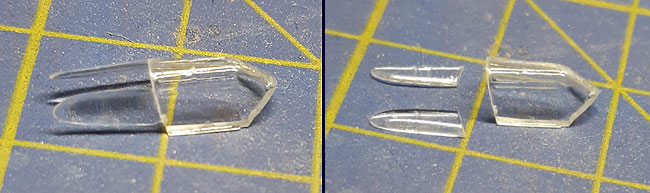
The canopy and rear windows
are supplied as one piece, above
left. I cut these apart to make it easier to install
the rear windows above right,
though in retrospect I may have actually made it more
difficult. The windows fit well into the recesses moulded
on the fuselage sides but they are so thin it would have
been impossible to just glue the edges. My thinking therefore
was that I could use a thicker adhesive which would also
act as a clear filler behind the windows. I tried clear
epoxy and Testors Clear Parts Cement, both of which looked
great when first applied, however they left large and
unsightly bubbles behind the clear parts once dry. I then
used Humbrol Clearfix which was slightly better, though
there are still a few bubbles which I just couldn't get
rid of. I was able to wick some Future into the bubbles
to reduce them still further, but alas, not eliminate
completely. I'm not entirely happy with the way these
turned out so I'll have to have a rethink before I tackle
the P-40E sometime in the future.


 Back
to 1/144th main
Back
to 1/144th main