Ah, Airfix. Where would
we be without them? For a good many years it looked like
the venerable old company was steadily declining and well
on its way to being put out to pasture. The same tired
old kits were released and re-released year after year,
many of which, dating from the dawn of plastic models,
should never have seen the light of day again. It seemed
Airfix would never survive the onslaught of new kits from
Japan, Korea and China that were produced with 21st century
moulding technology. And then Hornby took them over and
lo and behold, a transformation started taking place.
Shiny new Spitfires, Hurricanes and yes, the dreaded but
inevitable Messerschmitts appeared with accurate shapes,
recessed panel lines and good quality decals. Cockpit
detail was somewhat lacking and some of Airfix's ubiquitous
fit problems still plagued them, but it was a sign of
happy things to come in the manly scale, and Airfix did
not disappoint. Two lovely Swordfish biplanes were newly
tooled, a superb P-51 Mustang that is, in my most humblest
opinion, the best P-51 in 72nd scale (yes, even better
than the exalted Tamiya's small scale effort!) a late
mark Spitfire with superb cockpit and wheel well detail,
a Gnat jet trainer and this little baby, the Curtiss Hawk.
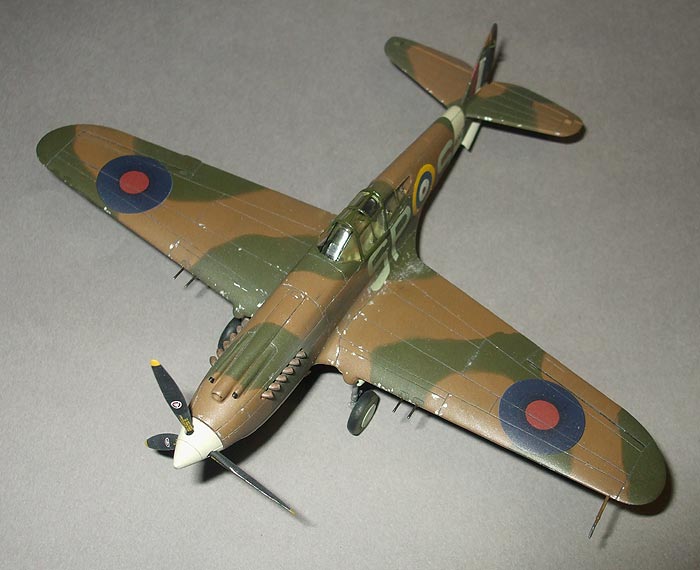
The kit is marketed as
a Hawk 81-A-2 but externally it's pretty much identical
to a P-40B. I did mine as a 400 sqn RCAF P-40B using decals
from an old IPMS Canada sheet. I added a bit of detail
to the landing gear and p/e seatbelts to the cockpit,
drilled out the exhausts, replaced the wing guns with
stainless steel tubing and repositioned the rudder and
elevators. Other than that it's a fairly straightforward
build, though there were still a couple of pesky fit problems
to deal with.
Paint is Humbrol enamel
for the Dark Earth and Sky with Polyscale British Dark
Green for the, uhhh... dark green. Interior is Model Master
interior green with olive drab for the floor. Exhaust
stains are a 50/50 mix of Polyscale Clear Flat and Grimy
Black with some brown pastels on top for good measure.
Muddy wheels are done with a brown pastel wash.
Left
and below: Nothing fancy here. I added photo etched
seatbelts and replaced the thick moulded flap lever with
a piece of plastic rod.
Left:
The only major fit problem encountered was at the wing
roots. Taping the wings to pull the tips up could have
solved it but may have introduced too much dihedral, though
in retrospect there might not be enough if this gap is
not corrected and the wings on mine might be a bit flat.
Oh well.
Left:
The canopy had a small hole next to the framing,
possibly caused by a shortshot or a defect in the
mould. The framing itself was very thin in this
area and had broken in my example. I fixed both
problems with a tiny spot of superglue that was
very carefully sanded and polished. Not an invisible
mend, but pretty close.
Right:
I added some .005" plastic bits to cover the spaces
in the cowl flaps.




 Left
and below: Nothing fancy here. I added photo etched
seatbelts and replaced the thick moulded flap lever with
a piece of plastic rod.
Left
and below: Nothing fancy here. I added photo etched
seatbelts and replaced the thick moulded flap lever with
a piece of plastic rod.
 Left:
The only major fit problem encountered was at the wing
roots. Taping the wings to pull the tips up could have
solved it but may have introduced too much dihedral, though
in retrospect there might not be enough if this gap is
not corrected and the wings on mine might be a bit flat.
Oh well.
Left:
The only major fit problem encountered was at the wing
roots. Taping the wings to pull the tips up could have
solved it but may have introduced too much dihedral, though
in retrospect there might not be enough if this gap is
not corrected and the wings on mine might be a bit flat.
Oh well.

 Back
to 1/72 Aircraft Main
Back
to 1/72 Aircraft Main