I was disappointed when
I picked up Osprey's "Nieuport Aces of World War
1" by Norman Franks whilst building this to find
that there wasn't a single photograph or colour profile
of Billy Bishop's aircraft in there. In fact, the only
mention of Bishop at all was one tiny paragraph in the
60 Squadron write-up! Hardly seems appropriate for the
RFC's second highest scoring ace, especially when Albert
Ball gets almost a page and a half. Mainly thanks to the
dubious docudrama "The Kid who Couldn't Miss",
Billy Bishop's reputation seems to have suffered irreparable
damage in the last few decades and the controversy surrounding
his award of the VC for a solo raid that can't be substantiated
by eyewitnesses or German records rages on. Perhaps Mr.
Franks shares this bias or maybe he just doesn't want
to get involved in the controversy, but Bishop deserves
far better than this. Personally I think every WW1 pilot
should have got a medal just for climbing in these frail
underpowered contraptions, let alone flying them through
snowstorms and getting shot at.
Never one to shy away from
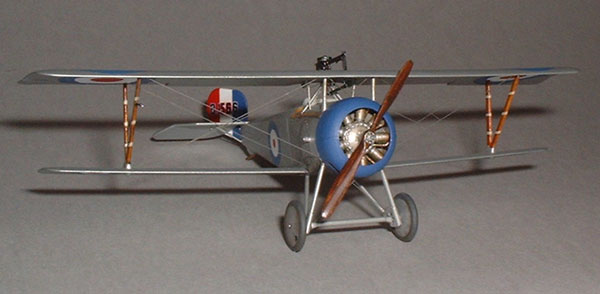
controversy, I present my own little tribute to Canada's
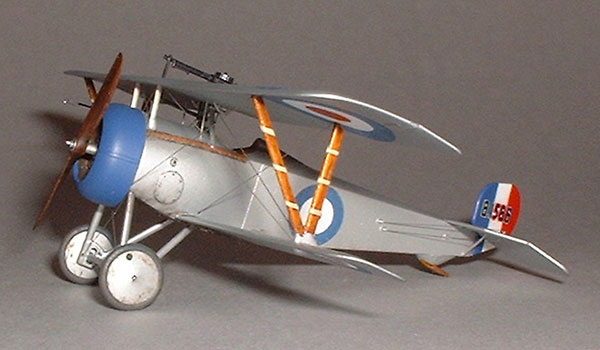
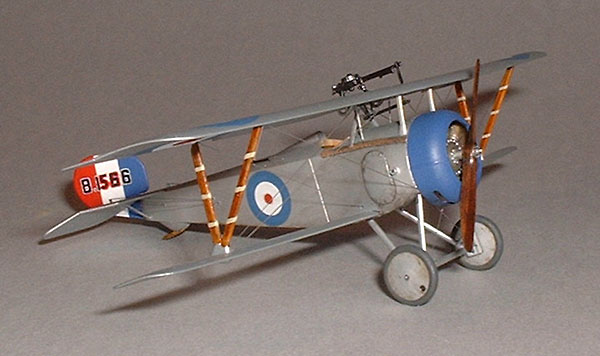
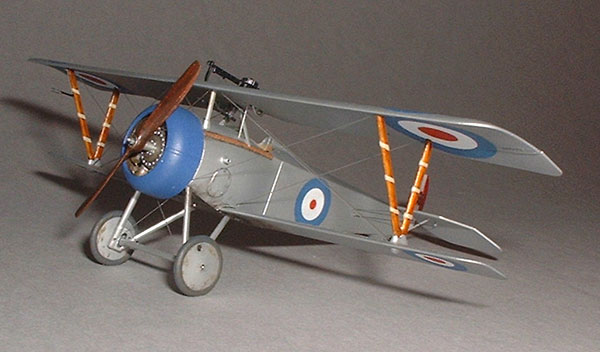
top scoring WW1 ace. Eduard's Nieuport 17 is one of the
easiest biplane kits I've ever built. The moulding is
superb, fit is excellent and the top wing - usually the
biggest source of frustration - lines up exactly as it
should do. There are a few things that require tweaking
and a bit of extra detail here and there never goes amiss
but then, what kit is perfect? And would the "perfect
kit" be as enjoyable to build? We'll probably never
know.... ¦¬)
I added a bit of extra
detail in the cockpit and substituted a p/e seat back
which is a much better representation of the typical Nieuport
seat than the kit item. Propeller is the usual carved
wooden effort, rigging stretched sprue, Aldis site is
from stainless steel tubing and windscreen from acetate.
My biggest complaint - perhaps my only complaint!
- with the kit is the engine which is really quite lame
(see construction page for details). Eduard didn't even
attempt to protray the cooling fins other than four very
faint grooves on each cylinder so I tried wrapping them
with fine wire to liven them up a bit. After numerous
episodes of broken and unravelled wire I gave up on this
idea in frustration and substituted the spare Le Rhone
from a Roden Camel which is far superior. I did cut off
the induction pipes from the Roden engine as I felt they
were a bit two-dimensional and used the seperate piece
from the Eduard kit.
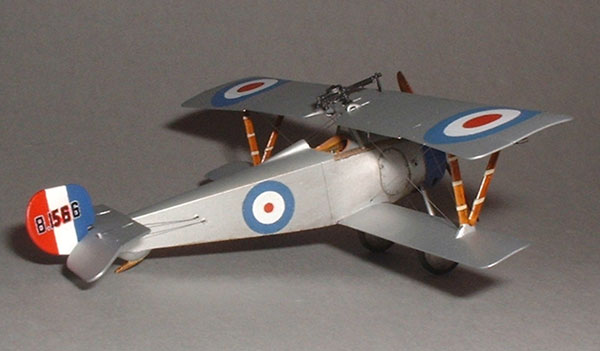
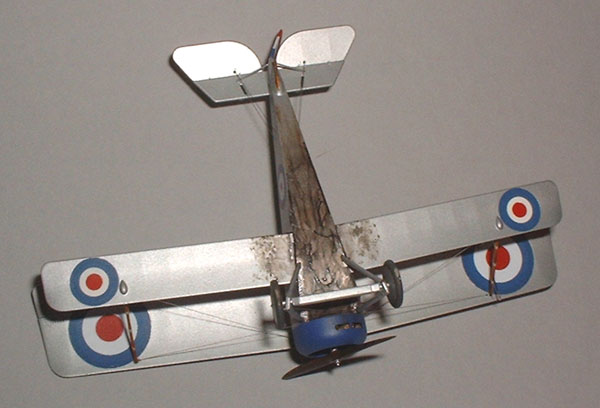
Paint is Poly S "Metalline"
Aluminum with a mix of Xtracolour Roundel Blue & USN
True Blue for the cowling & rudder stripe. Roundels
are from Americal Gryphon with the tail codes pieced together
from their No. 1 Squadron sheet. For some reason AG printed
the red outlines exactly the same size as the black numbers
which kind of defeats the purpose so I hand painted the
outlines with a #00000 brush - not fun! Bishop's aircraft
is nearly always depicted in paintings with large black
'5s' & 'Cs' on the wings & fuselage and blue wheel
covers but I have yet to see a photograph of it painted
this way. I finished mine as it appears in the only photo
I've ever seen of B.1566.
Note that the fuselage
exit holes for the elevator control wires are moulded
asymmetrical; one side has the upper hole forward with
the other side the reverse of this. I originally thought
this was a mistake but checking photos I discovered that
this is actually correct for some aircraft. Unfortunately
not this one! Naturally I didn't discover it until it
was far too late to correct it without major destruction
and repainting. Actually credit must go to Matt Bittner
for pointing this out - I probably would have never noticed
it! Great... thanks a lot Matt... ¦¬|




 Back
to 1/72 Aircraft Main
Back
to 1/72 Aircraft Main Construction