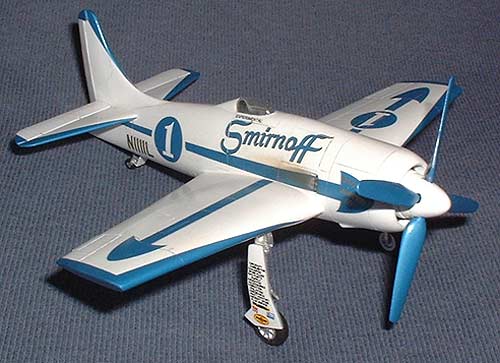
In 1966 Lockheed test pilot
Darryl Greenamyer won the Unlimited Class race at Reno
in this highly modified Bearcat which was the start of
a 4 year run of first place victories. On August 16th
1969, with a speed of 482.463 mph, he broke the world
absolute propellor-driven speed record that had been held
since 1939 by Germany's Fritz Wendel in the Messerschmitt
Me209 V1. The Bearcat would be modified many times over
the years and sport several different eye-catching paint
jobs of which this 1966 blue and white scheme is my personal
favourite. And I don't even like vodka.
I had no problems with
the Bearcat's construction other than the usual minor
headaches associated with a limited run kit. The plastic
parts are very well moulded and sport fine recessed panel
lines. So fine, in fact, that I knew they would disappear
under the many coats of white paint needed to cover the
lovely pale blue plastic, so I decided to deepen them
with a scriber. In contrast to many racing aircraft, Greenamyer
doesn't seem to have bothered much with filling the panel
lines and they are quite noticeable in photos so I considered
the re-scribing to be a necessary evil.
The only other problem
worth noting concerns the decals. Though they are beautifully
printed and go down well, the markings for the horizontal
stabilisers are not handed, which means they will only
work on the top of the right and bottom of the left stabs
without modification. Fortunately this was very easy to
overcome with a little experimentation. I floated the
incorrect decals off the backing paper and let them soak
for a bit to wash the glue off. Then it was just a matter
of turning them upside down (obviously this won't work
on decals that are more than one colour or have a white
backing), placing them on some wet decal paper to "re-glue"
them on the correct side and then applying them in the
normal fashion. I also wish there had been more spare
trim decal on the sheet as I had a hell of a time trying
to match that metallic blue colour in order to paint the
prop. In the end I used all the spare decal on the front
of the blades and cobbled together the remaining bits
for the backs. It's a bit of a patchwork affair but fortunately
the decals blend together very well once they are dry
and a clear topcoat is applied.
I removed the
moulded-on exhausts with a Dremel and then made new ones
from heat stretched tubing. These and the pitot were the
last items added. Exhaust and oil stains were airbrushed
on with a very thin mixture of Pollyscale clear flat and
dark gray and then finished off with brown pastel chalk.
I was a little hesitant to add exhaust stains, fearing
it would detract from the pristine racy look, but almost
every picture of this aircraft show it to have some staining
and burnt paint behind the exhausts so I thought I should
give it a bit of weathering. In fact, in some photos the
dark brown exhaust trail goes all the way back to the
rudder, making it look dirtier than your average combat
aircraft. In the end I was quite happy with the slightly
used finish - I think it kind of adds to the potent look
of the aircraft.
I should mention at this point that I damn near ruined
the model when I added a wash to the panel lines. My own
personal preference when it comes to panel lines is to
err on the subtle side. I'm not a big fan of pre or post
shading, it looks heavy handed and unrealistic to me,
and I don't like overbearing black washes either. So I
picked what I thought would be a nice medium gray enamel.
Against the white paint however it ended up looking almost
black and the panel lines were jumping out at me. It looked
bloody awful in fact! My attempts to remove said wash
met with failure and I was beginning to think a sad end
was in store for the model. In desperation I ran a thin
wash of Tamiya White over top of the gray and this had
the desired effect. It took three thin coats but I finally
managed to tone down the panel lines to an acceptable
level. Whew!! Mental note: Medium gray is not the
way forward on white paint.
White metal gear legs
and a beautifully clear (but tiny!) vac formed canopy
complete this high quality offering from High Planes.
If I were writing for one of the major modelling magazines
I guess I would finish off the article with something
like, "High Planes' Smirnoff Bearcat is a colourful
and unusual addition to my collection and I highly recommend
it". But I'm not, so I won't. ;-)
Above
left: Exhausts made from heat stretched tubing.
Bit of a close-up here, obviously. Above
right: Completely forgot about that little ventral
strake until the model was almost finished. Fortunately
it was easy to add from strips of .005" plastic.
I just scribed a line where it needed to go and then stuck
it on with liquid cement. Tamiya White was brushed on
to match the rest of the paint.
In addition to "Bent
Throttles", the bi-monthly newsletter that used to
be put out by The IPMS Racing & Record Aircraft SIG
(I'm not sure if this SIG still exists), the main references
used for this model were "Reno Air Racing" by
Michael O'Leary (Motorbooks International) and WarbirdAeroPress.com.
The latter now seems to exist only on Facebook and hasn't
been updated since 2016 unfortunately, but it had excellent
photos of this and many other racing aircraft.




 Back
to 1/72 Aircraft Main
Back
to 1/72 Aircraft Main