Another of those quick, easy, out-of-the-box
builds to help me get through a bad case of modeller's
block. That was my intention when I started this thing
two years ago anyway. It didn't quite work out that way
of course; it rarely does.
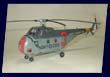
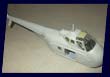
The Italeri kit is very good and goes together well though
there are some bizarre anomalies and inaccuracies. Two
of the braces on the screening under the windshield are
missing on the right side for instance, a fact I didn't
notice until the kit was almost complete and had to carefully
add from plastic strip to avoid damaging the paintwork.
Also, while they include the step on the left and have
moulded holes to glue it in, they neglected to represent
this on the right side. The step was a bit thick anyway
so I made both from brass rod as well as the large one
under the sliding door which was also missing from the
kit. There were some round lumps moulded on the spine
of the fuselage which I could not see in any photos of
these machines so I removed them along with the beacon
directly behind the rotor head. This should be located
on the spine in line with the navigation lights on the
fuselage sides. I added this from a small piece of clear
red stretched sprue. The antenna fit was nothing like
that on late RCN aircraft so these were made from .005"
plastic with the taller forward one coming from the scrap
box.
The hoist that Italeri include represents the early version
fitted to HO4S-2s and possibly some early -3s. I intended
scratchbuilding the later version until I discovered a
picture of this particular machine which shows it didn't
have a hoist fitted at all - problem solved! Of course
I didn't find this picture until I had already drilled
holes for the new hoist so had to improvise and fit tiny
mounting brackets made from scraps of photo etch frame
to cover the holes. The one in the window (the top mounting
goes through the rear window on the right side) I had
to leave as is.
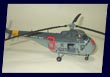
(Click
thumbnails to change image)
Paint is Xtracolour Medium Sea Grey
and Extra Dark Sea Grey with Humbrol flat black &
gloss yellow on the rotor blades. The main rotor head
was done in Testors Metalizer Steel with a wash of dark
grey and a dry brush of Humbrol Metalcote Aluminium.
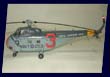
I used decals from the Belcher Bits helicopter sheet,
a decision I was to regret when it came time to apply
them. There are several problems with these decals, the
biggest being that no concessions were made to the extreme
compound curves of the beast when designing the sheet.
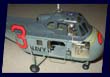
The large '3' on the nose was the worst offender, when
first applied it was so distorted it very nearly became
an '8'! I had to do some serious cutting and patching
to get it to even remotely resemble a '3'. The large numbers
on the side also required a bit of slicing and dicing,
though were nowhere near as bad.
There was a similar issue with the Royal Canadian Navy
markings. Though they were printed at the regulation height
of 10 (scale) inches, when applied over the large strengthening
strake on the tailboom they became almost illegible. Fortunately,
Italeri took this into consideration and printed theirs
quite a bit taller so I used the markings from the kit
sheet, though they were spaced too closely together and
had to be cut into three seperate words and spaced apart
properly when applied.
Despite the Belcher Bits instructions saying that the
tail rotor warnings had red arrows with black lettering,
these markings were printed entirely in red. I had to
steal the lettering from one of the Sea King options from
the same sheet to correct this. As a final ignominy, the
maple leafs on the roundels were out of register so I
used some from an old IPMS Canada RCN sheet. On the plus
side, the BB decals are nice and opaque and settle down
very nicely with applications of Microsol. Nonetheless,
it was a lot of work to get them to look halfway decent
and with the nasty patch job on the nose being quite noticeable
up close, I was rather disappointed with the Belcher Bits
decals.
Most of the Canadian HO4S-3s had a small triangular red
flag on the lower antenna wire, which I imagine was there
to stop people tripping over the wire on the ground and
breaking their necks. I made this from a small triangle
of cigarette paper soaked in diluted white glue and painted
flat red when dry. The wire itself was stretched sprue.
Actuating rods on the main and tail rotors were far too
thick and were replaced with .015" plastic rod.







 Back
to 1/72 Aircraft Main
Back
to 1/72 Aircraft Main