I remember being terribly
excited as a child of 10 to get a Revell Orange Crate.
I was easily amused. I also remember the lovely shower
of chrome bits that ensued when said Crate later hit the
wall at high velocity. Apparently, it was a bit advanced
for me at the time. Fast forward several, ummm... decades
(gulp) and the 10 year old child in me thinks he
has progressed enough to tackle the dreaded Orange Crate.
Dang upstart youngster, a good cuff upside the head, that's
what he needs.
In retrospect, it's pretty
obvious why I didn't have such a spiffy time building
one of these back in 1975: chrome, and lots of it. The
key to my shame was that omnipresent line in car instructions
that I always ignored. "Scrape chrome away from parts
that are to be glued", or words to that effect. See?
I still don't pay attention to it. There are just way
too many chrome pieces to be scraped on this thing to
appeal to the limited attention span of a 10 year old
- or even a 40 year old for that matter. This time I adopted
a different approach. I got rid of the chrome entirely,
which was a quick and easy job with oven cleaner and an
old toothbrush. The slow and difficult part was cleaning
up the horrible seams and flash and filling the multitudinous
ejector pin marks. This took a good many hours and was
about as enjoyable as that "Manual Disimpaction Awareness"
seminar I attended at the local retirement home. Once
everything was cleaned up - and not just at the retirement
home - most of the pieces actually fit together very well,
especially given the age of the moulds.
Now I've tried many a shiny
silver paint over the years that claimed to be "chrome"
but were in reality just shiny silver paint. In fact they
looked about as chrome-like as a Chihuahua that had been
dipped in bacon fat and buffed with an electric floor
polisher. So it was with a great deal of skepticism that
I elected to give Alclad II's rendition of chrome a try
for the first time. I'm pleased to say my doubts were
completely unfounded. The stuff is excellent and it actually
looks like chrome. In fact, I would say it looks much
better than the chrome plated parts you get in car kits
which are usually far too bright and shiny. I wasn't too
sure about having to apply a coat of gloss black so I
tried it without, but the Alclad finish is much duller
without the undercoat. It does have the advantage that
you can at least check how the surface looks before you
lay on the chrome. Alclad II will take a certain amount
of handling but will still wear off the edges rather easily,
so it's best to handle the parts as little as possible
or wear gloves. All in all, it's damn fine stuff. A little
pricey (4 of the Queen's finest sterling for a 1 ounce
bottle) but it's more economical and practical than getting
the parts re-plated and I really don't think I could have
completed the ol' Crate to my satisfaction without it.
Obviously this wasn't an option in 1975 and it probably
wouldn't have helped me much at the time anyway.
The decals were a bit of
a nightmare in spite of the fact that they were beautifully
printed and very thin. So thin in fact that they broke
into a buh-zillion pieces when I tried to apply them.
Well okay, that's a slight exaggeration. Maybe it was
only half a buh-zillion pieces. Anyway, it took me a good
half hour (as opposed to some other kind of half hour?)
to re-build my shattered nerves along with that shattered
rear decal. And when I was finally able to sit back, slurp
a stiff drink of tea and admire my handiwork it suddenly
occurred to me that the decal now read "ORANGE RATE".
Aaaaaaarrggh!!! Where's the @*%$!£?ing 'C'
gone?!?! Cleverly hidden under one of the many other bits
of decal, that's where. Fortunately, with copious amounts
of water I was able to move everything about and return
the recalcitrant 'C' to its proper position. It's enough
to make you become an airplane modeller I tell ya. Oh
wait.... I am an airplane modeller. Well, no wonder
I had trouble - there's no 'C' in airplane.
The best reference for
the Orange Crate is actually the colour picture on the
box top, though there were some good black and white photos
on the Road & Track site. Sadly, these seem to have
disappeared. Like most racers - whether they be cars or
airplanes - the details changed often. The supercharger,
for instance, is a dull aluminum colour on the box top
whereas later it was polished aluminum or chrome and the
inside of the body appears to be natural metal in some
of the black & white pics instead of the black seen
in the colour photo. I think the wheels and fuel tank
should be polished metal rather than the chrome that Revell
have finished them in, but I didn't realise that until
I had already painted them. The difference is fairly subtle
anyway so I can live with it.
The front wheel mounts have a lot of play in them which
made it a fairly easy matter to turn the wheels a bit,
but of course the tie rod then needed to be modified slightly
as well. Other than that and replacing the flimsy rear
axle with 1/16th" music wire and adding spark plug
wires, this is built pretty much out of the box. The exhausts
were particularly bad mouldings and needed a lot of work
to even remotely resemble round pipes. I then drilled
and hollowed these out as well as the vents on the cylinder
heads.
Et voilà: car #
2. A worrying trend you ask? Steering away from aircraft
(which does have a 'C' in it) and driving down the highway
of shiny cars for good? Nope, not at all. Just an occasional
diversion from the world of wings, wires and politically
correct panel lines. That's my story and I'm sticking
to it.
Above:
That was the best fit I managed to get out of that resin
hood. The other side looks even worse. I understand the
hood is resin in this re-release because the original
mould was damaged or missing. Or perhaps resin is more
impact resistant than plastic when striking a large immovable
object (like a wall, for example) at high velocity.
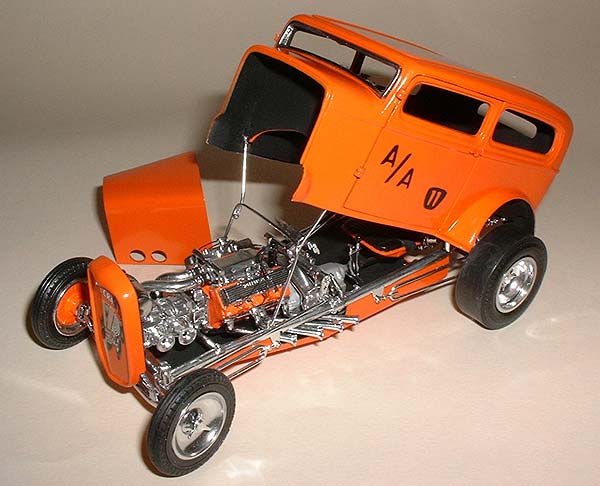
Above
& Below: It works! Well, temporarily anyway.
I had a nasty feeling it was going to go very badly if
I kept playing with this thing and I intended displaying
it with the body up anyway so I glued the support after
taking these pics.
Note that, unlike Revell's kit, the door handles should
be orange, not chrome, and the longer bits should point
to the front instead of the rear as Revell have them in
the instructions.
Above:
I didn't like the clunky body support so I made
my own from .030" brass rod with thin slices
of 1/16th" tubing for the hinges. I think it's
a big improvement in spite of the fact that my initial
attempts at soldering were about as successful as
a pair of bamboo underpants.
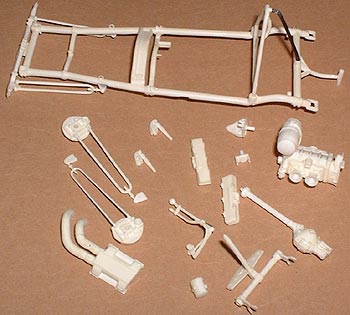
Above:
All plated parts were stripped with oven cleaner
and then the real fun began. It may not look like
much, but this picture represents a good many hours
of filing, filling, sanding & polishing. Oh,
and a bit of glueing.
Note the replacement rollbar support, the original
having done a runner down the drain when I was rinsing
the oven cleaner off. Oops.
Left:
Amazing what you can do with a couple of Reheat
1/72nd scale data placards and an instrument dial.
Someday I'll even try them on a 1/72nd scale plane.





 Left:
Amazing what you can do with a couple of Reheat
1/72nd scale data placards and an instrument dial.
Someday I'll even try them on a 1/72nd scale plane.
Left:
Amazing what you can do with a couple of Reheat
1/72nd scale data placards and an instrument dial.
Someday I'll even try them on a 1/72nd scale plane. Back to 1/25th Cars Main