Time flies when you're
having fun. Yes, it really has taken me one week shy of
4 years to finish this. I know, I know, nag, nag, nag....
What can I say? I'm very good at starting things, not
so spiffy at finishing them. And I'm slow.
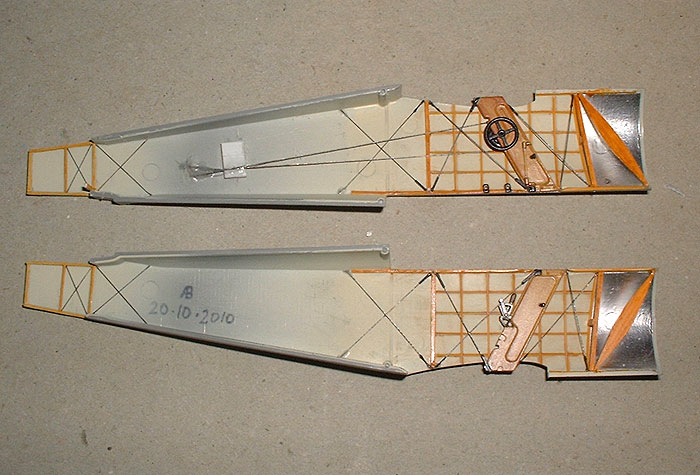
Roden's interior leaves a lot to be desired I must admit.
Other than the cabane struts that extend into the cockpit,
the trim wheel, throttle, the upper longeron and the small
stringers moulded to the fuselage side, there isn't much
else in there. I added the missing framing and rigging
and cut off the fuel contents guage moulded to the starboard
strut and replaced it with one from stretched clear sprue.
Rather than painting the frames, I did them with thin
strips cut from a Pegasus wood grain sheet. Much quicker
and easier than trying to mask and paint them.
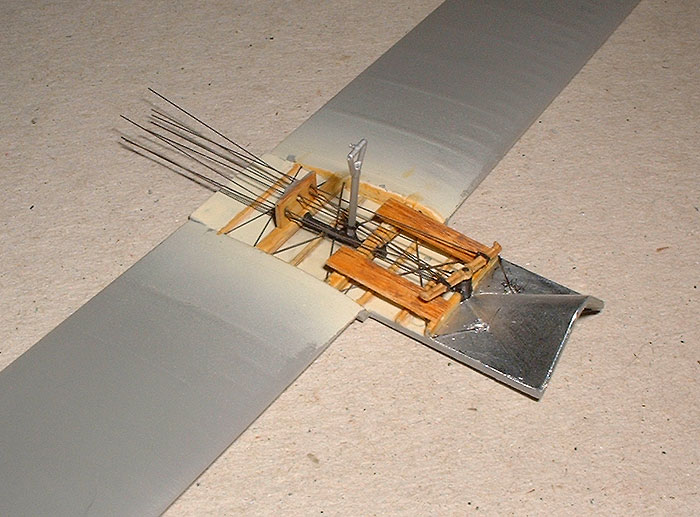
Control cables were added
to the cockpit floor and the heelboards replaced with
real wood. Not that plastic stuff I tells ya, real wood
for that authentic real wood flavour. Similarly, the forward
metal bits were covered in Bare Metal Foil, or real metal.
This is both an homage to full scale construction methods
and a testament to my laziness when it comes to painting.
For the control cables I used some fine braided wire I
found in the beading section of the local craft store.
This is .012" in diameter and has a plastic coating.
Burning the coating off yielded lovely braided wire about
.010" in diameter, perfect for this scale. It comes
on a reel so has a natural curve to it. I removed this
by clamping it in a vice and hanging a weight off the
other end, then coated it with superglue. Once dry it
stayed nice and straight, the superglue having the added
benefit of stopping it from fraying when cut. This was
also used for the internal bracing wires with fine stainless
tubing representing the turnbuckles.
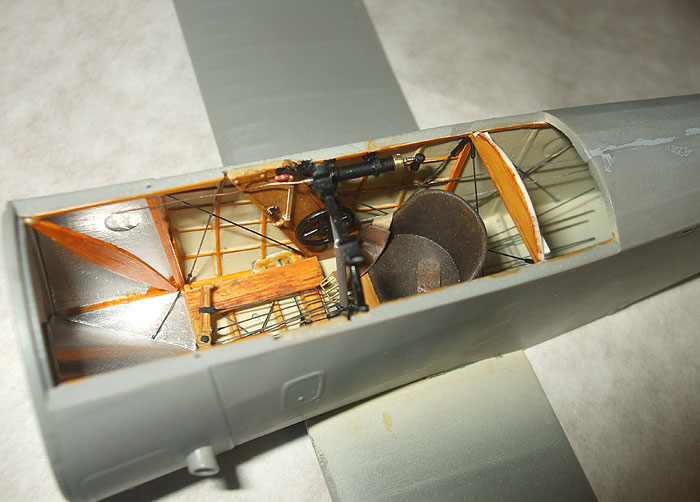
Above:
The cockpit looks fairly busy and Triplane-like
when done.
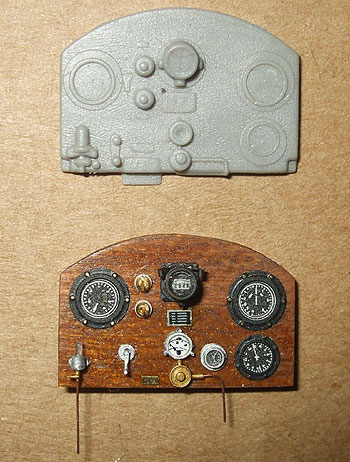
Left:
The kit instrument panel is actually pretty good.
Suitably painted and with a few instrument decals
it would be just fine, and once the coaming is
on and the guns are in place it isn't too visible
anyway. Rather than trying to paint it however
- simulated wood grain not being my forté
- I decided to make a new one from thin mahogany
veneer, Aeroclub photo etched bezels, Reheat and
Airscale instrument decals and a few scratchbuilt
bits and pieces. It worked out okay I guess.
Below:
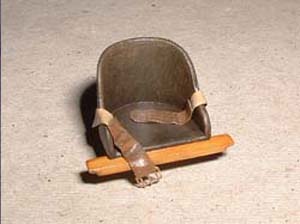
Seat belts are made from lead foil with buckles
from wire.
Below
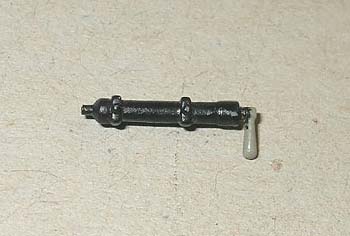
left: The kit supplied grease gun was
okay, but I couldn't think of a better time to finally
try out that Unimat lathe I bought off a friend ages ago.
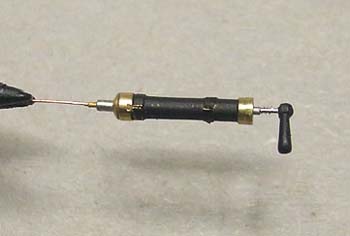
Below right:
It took me a couple of attempts but I managed to create
one from brass stock in said lathe. The handle from the
kit part was used after some clean up and the mounting
brackets are cut from .005" sheet brass. A spring
from fine wire completed the job.
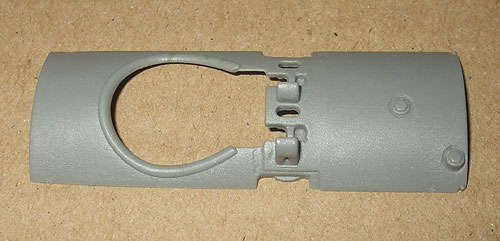
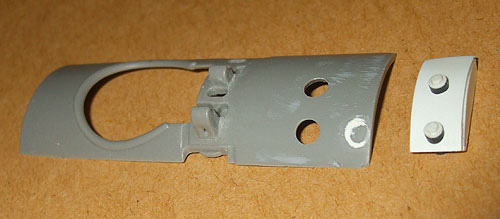
Left:
The fuel fillers were in the wrong place and were
a bit soft on detail.
Right:
The incorrect forward filler was removed and filled
and the correct locations were drilled. A scratchbuilt
"faux tank" was made and glued underneath.
The filler caps were made from tubing capped with
punched discs and topped with hex heads punched
out with a Historex punch and die set.
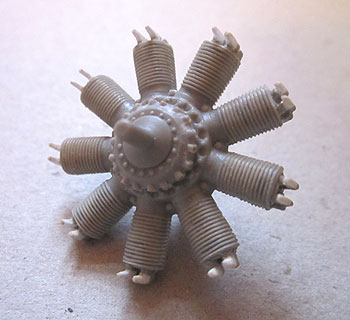
Left:
The kit Clerget engine isn't too bad really. I did
consider replacing it with a resin engine from Vector
but thought I'd try and do something with the Roden
one instead. The engine is in front and rear halves
so probably the most time went into cleaning the
seams between each cooling fin. I used the edge
of a cutting file and the tip of an X-Acto knife
for this. The cylinder heads and valve assemblies
are the poorest part of the kit mouldings but they
aren't very visible once the cowling is on anyway
so I wasn't too concerned with this. I cut off the
pushrods and drilled holes for new ones in the crankcase.
New rocker arms were made from .030" x .040"
strip, filing and sanding these to shape once dry.
I wasn't after accuracy here, I just needed something
to attach the new pushrods to.
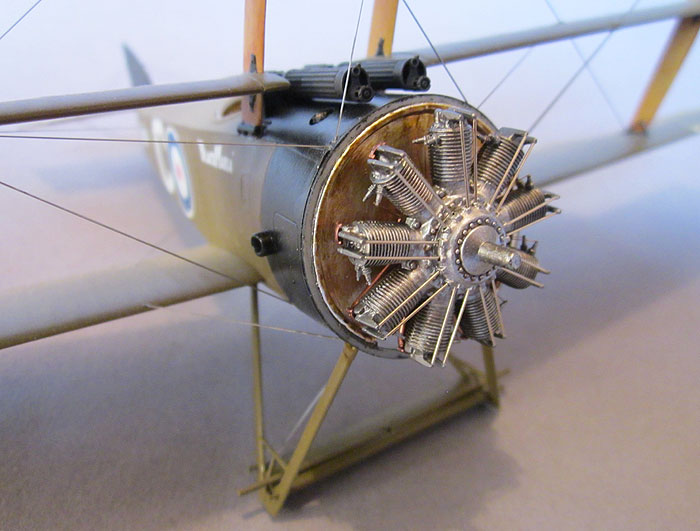
Below:
The completed engine installed on a suitably oily
firewall. Pushrods are 0.33mm Nickel Silver rod
from Albion Alloys. Spark plugs are resin items
from Taurus Models superglued into holes drilled
in the cylinders, the leads are from fine copper
wire. The spark plugs are nerve wrackingly tiny
and a couple of them launched themselves into space
while I was trying to insert them, never to be seen
again. Well worth the effort though I think. Paint
is Alclad Aluminium and the oily wash consists of
Humbrol Acrylic Service Brown mixed with a bit of
Tamiya Clear Yellow. Induction pipes are Alclad
Copper, though you'll be hard pressed to see them
on the completed model. Once the cowling is on,
the engine is good enough for me.


 Back to Triplane Main