I feel a sense of loyalty
to Roden. Long before that New Zealand upstart was a glint
in a certain film producer's eye, Roden was quietly amassing
an extensive catalogue of WWI aircraft kits in all the
popular scales. Sure, some of their efforts aren't quite
as nice as Wingnut's are, and they may not fall together
as easily, but Roden held fast to an era that most manufacturers
wouldn't touch with a barge pole at the time and for that
they deserve our thanks and our patronage. The last time
I built a 1/32 scale kit I was about 15, so I'm pleased
that it was a Roden kit that got me back into large scale
after all these years. Of course, I'm still mainly a 1/72
fan, but I'm sure an occasional foray into other "lesser"
scales won't kill me.
While I have no doubt that
the WNW Tripe is far superior, Roden's kit still has a
lot going for it. It's well engineered and fits together
as it should. It gives you the option of a single or twin
gun aircraft, and there are some interesting decal choices
as well, though it's perhaps no surprise that I went with
the fairly banal choice of Collishaw's machine. Yes, it's
become almost as much of a cliché as that pesky
red triplane on the antagonist side has, but you can't
argue with the success of the Black Flight and its leader.
And hey, they were there well before that Red Baron guy
flew anything in combat that had more than two wings!
It is an accurate kit with
one exception, and to be honest I would never have noticed
it if Mr. Rimell hadn't pointed it out in his review in
Windsock Magazine. The fuselage is, apparently, 5mm too
short. Now that sounds like a lot, and I suppose it is,
but honestly it really isn't noticeable. Even when I sat
it next to my WNW Sopwith Pup the error isn't obvious
(the Triplane is essentially a Sopwith Pup with three
wings, the fuselages are pretty much identical other than
the wing mountings). Even if I hadn't been well into the
build when I read the review, I probably wouldn't have
done anything about it. Seriously, can you tell
it's 5mm short...?!
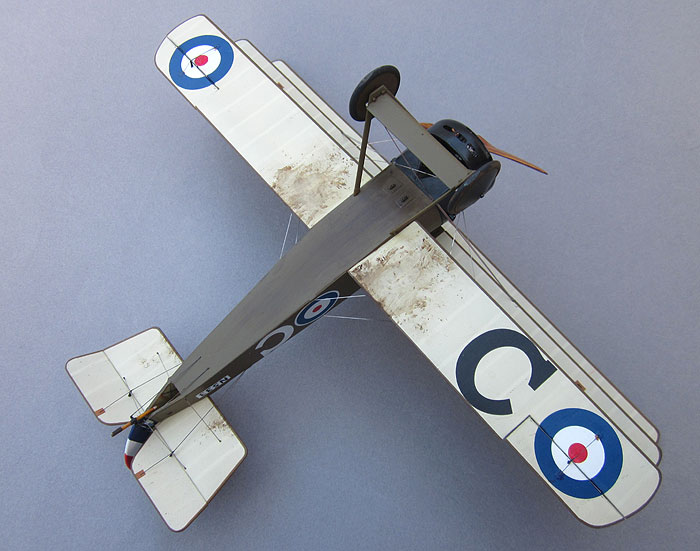
I didn't go overboard on
the weathering since this wasn't a well used aircraft,
at least not by Collishaw; he was only known to have flown
it on seven patrols, shooting down one Albatros and sending
another out of control on his last flight in this plane.
Other than the usual oil stains and mud, the only weathering
was a bit of chipping around the metal panels and some
blast marks under the muzzles of the Vickers guns.
The prop was carved from
wood as is my standard practice for WWI aircraft, though
in this case I laminated alternating layers of thin oak
and mahogany veneers together instead of carving it from
plywood as I do in smaller scales. The prop boss was carefully
sliced off the kit prop and then sanded down paper thin
before painting with Metalizer steel and gluing on. This
worked a treat and solved the dilemma I had about how
to tackle the prop boss.
Vickers guns are 3D printed
jobbies from Gaspatch Models. They are expensive, but
well worth it. The kit guns aren't bad, but it would have
taken a considerable amount of effort to get them looking
anywhere near decent, and even then they wouldn't have
been a patch on Gaspatch, so to speak.
The etched rigging is from RB Productions. This worked
very well and was actually quite easy to install, however
my choice of adhesive wasn't really up to the task. I
went with epoxy, thinking that as it was slightly more
flexible than superglue it might allow some give and therefore
not break as easily. That turned out to not be the case
and I had quite a bit of slack rigging to fix, caused
by handling the model during final assembly. It's worth
noting that the Tripe has very few external turnbuckles,
they are present only on the flying wires. These I represented
with blobs of black paint.




 Back
to 1/32 Aircraft Main
Back
to 1/32 Aircraft Main To
the construction page!
To
the construction page!